


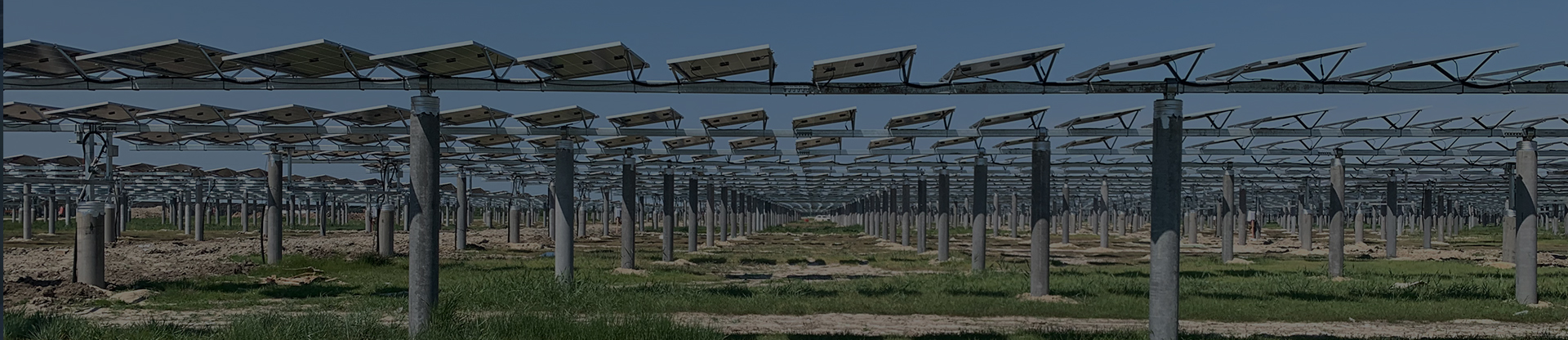

Project Location: Vulcan County, Alberta, Canada
Project Capacity: 50 MW DC (Illustrative)
Tracker Type: Dual-Axis Solar Tracker、Horizontal Single-Axis Solar Tracker
Module Configuration: 2P
Application: Utility-Scale Solar Power Plant
Project Overview: Solar Tracking System for a Cold Climate Project in Canada
Canada's renewable energy market continues to create opportunities for utility-scale solar development, particularly in Alberta, where large-scale photovoltaic installations are becoming an important part of the regional energy transition.
However, developing solar power projects in cold climates presents specific engineering challenges. Long winters, heavy snowfall, freezing temperatures, and changing weather conditions can affect the structural performance and operational reliability of solar tracking systems.
For this illustrative 50 MW utility-scale solar project in Vulcan County, Alberta, a cold-climate solar tracking solution is proposed to address these environmental challenges.
The system combines a high-strength structural design, intelligent snow stow functionality, and low-temperature-compatible electrical and mechanical components to support reliable operation throughout the year.
The objective is to provide a solar tracker for cold climates that meets project-specific structural requirements while helping maintain consistent tracking performance under challenging winter conditions.
Key Challenges of Solar Tracker Installation in Cold and Snowy Regions
Solar tracker installations in northern regions require more than conventional tracking technology. Several environmental factors must be considered during the engineering and system design stages.
1. Heavy Snow Load and Structural Stability
Heavy snowfall can create additional loads on photovoltaic modules, torque tubes, support posts, bearings, and connecting components.
If the solar tracking structure is not properly engineered for local snow conditions, accumulated snow may increase structural stress and affect long-term system reliability.
For projects in Canada, the structural design must consider local ground snow loads, exposure conditions, snow accumulation patterns, and applicable building codes.
A reliable solar tracker for snowy regions should therefore feature a site-specific structural design, suitable steel materials, and properly engineered foundations.
2. Snow Accumulation and Reduced Winter Power Generation
Snow accumulation on solar panels can block sunlight and reduce photovoltaic power generation efficiency.
For dual-axis solar trackers and single-axis solar trackers, an intelligent snow removal strategy helps address this challenge.
By tilting the modules to a steep angle, the system can promote the natural shedding of snow under suitable weather and ground conditions. This is not only supported by our experimental data, but has also been verified and confirmed by multiple customers: after snowfall, adjusting the photovoltaic panels to face the sun directly—either automatically or manually—causes the snow to melt and slide off quickly, which is highly effective. This feature helps quickly restore power generation after snowfall.
3. Extremely Low Temperatures and Equipment Reliability
Cold weather can affect the performance of motors, controllers, electrical components, and mechanical connections.
In regions experiencing prolonged freezing temperatures, the selection of suitable low-temperature components becomes essential.
Solar trackers designed for cold climates should consider:


- Reliable communication and control systems.
- Low-temperature motor performance.
- Suitable lubrication and bearing materials.
- Cable and connector temperature ratings.
- Reliable communication and control systems.
These considerations help ensure that the tracking system operates within its specified environmental limits.
Our Solar Tracker Solution for Cold Climate Applications
To address these challenges, the proposed solar tracking solution integrates three key engineering features.
1. High Snow Load Structural Design
The tracking structure is designed in accordance with the environmental conditions and structural load requirements of Alberta. The primary structural considerations include:
The objective is to maintain structural integrity under demanding winter conditions while providing a reliable foundation for long-term solar power generation.
2. Equipped with intelligent snow removal function


- High-strength galvanized steel structural components.
- Optimized torque tube and support post configurations.
- Engineered connections and mechanical joints.
- Foundation design based on local soil and frost conditions.
- Structural calculations for site-specific snow and wind loads.
When snowfall or specific weather conditions are detected, the tracking system can move the photovoltaic modules to a preset steep angle position.
This enables gravity to assist in removing the snow from the module surfaces.
A flexible control strategy is provided for snowy environments. The snow removal strategy can be configured according to local weather conditions, module specifications, tracking range, and structural limitations.
3. Reliable Low Temperature Operation
Reliable operation in freezing conditions requires careful component selection and system configuration.
For this project, the illustrative design targets a minimum operating temperature of -40°C.
The electrical and mechanical systems are selected according to the required environmental specifications.


- Reduce the accumulation of snow on the solar components of the tracker, enabling faster power generation recovery after snowfall.
- This helps to enhance the continuity and reliability of winter energy supply.
- We provide customized and flexible control strategies for snowy environments.
Technical Specifications of the Cold Climate Solar Tracking System
| Specification | Illustrative Design |
| Project Capacity | 50 MW DC |
| Tracker Type | Horizontal Single-Axis Tracker |
| Module Configuration | 1P |
| Tracking Range | ±60° |
| Minimum Operating Temperature | -40°C |
| Design Wind Speed | 55 m/s |
| Snow Stow Angle | Up to 60° |
| Snow Load Design | Site-specific engineering |
| Tracking Control | Smart Tracking System |
| Snow Protection | Intelligent Snow Stow |
| Structural Material | High-Strength Galvanized Steel |
| Design Life Target |
25–30+ Years |
(The parameter values of the photovoltaic support structure are customized according to the project.
Due to differences in latitude, climate conditions and terrain,they need to be designed and tested based on the actual situation.)
4. Optimized Solar Tracking Algorithm
The tracking algorithm is set based on GPS and local solar time. Combined with the AI algorithm, it adjusts the orientation of the components according to the position of the sun. The panels always face the direction of the sun to continuously capture high-efficiency solar radiation throughout the day.
5. Solar Tracking System Monitor
Remote monitoring and operation data are helpful in identifying abnormal situations and supporting maintenance plans during the winter period.
The energy production in winter depends on the local solar radiation, snow cover conditions, characteristics of photovoltaic modules, system availability, and project configuration.
Therefore, real-time operation data or verified energy simulations should be used to evaluate the performance improvement effect.
Are you looking for a reliable solar tracking system for your project?
Whether you are building large-scale utility-scale photovoltaic power stations, undertaking photovoltaic power generation projects, or installing renewable energy equipment in cold regions, deserts, or complex terrain areas, choosing the right solar tracking system is of utmost importance.
Our engineering team can assist in evaluating your project and meeting the requirements for latitude, terrain and landform, climate, hours of sunlight, maximum and minimum operating temperatures, wind conditions, and tracking configuration.
Please contact us to discuss your project needs and explore our tailor-made solar tracking solutions for you.
Zhaori(Protracker)-Your Reliable Partner For Manufacturing Solar Tracking Systems.