


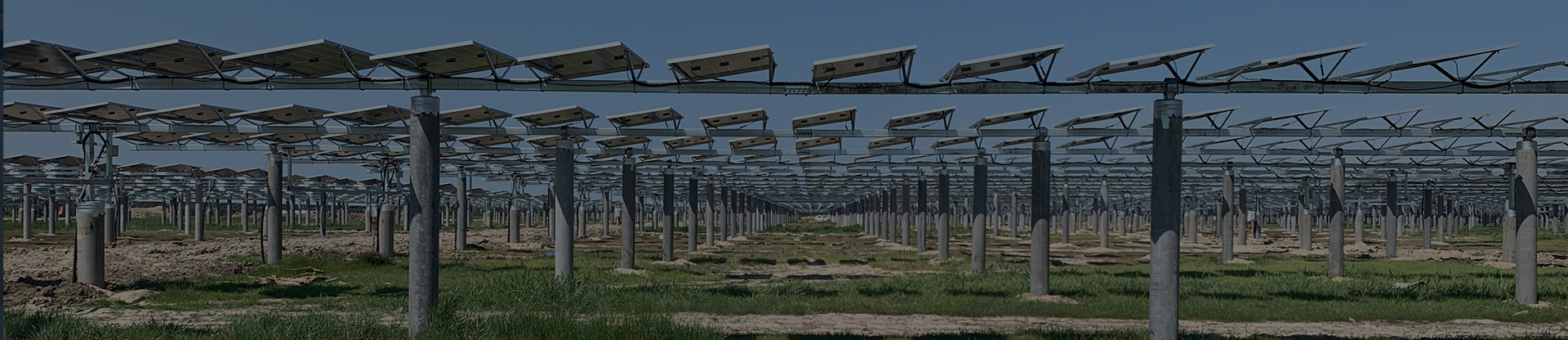
Identical photovoltaic panels installed on the
(sunflower-style)solar tracking brackets can boost daily power output by 20%–35%.
However, the rotation of brackets involves far more than capturing sunlight; integrated algorithms enable shade avoidance, wind resistance and weather adaptability, serving as the core “digital brain” of the entire system.

At large-scale PV power stations, trackers face east at dawn and swivel west at dusk, distinct from fixed racks with permanent mounting angles. The 10%–35% power gain generates substantial revenue for ground-mounted power plants, driving widespread adoption of tracking brackets. Nevertheless, sun-chasing projects face three major challenges: real-time accurate solar positioning, inter-row shading mitigation and equipment protection under gales, all resolved by tracking algorithms. This analyzes four core algorithmic functions, three control strategies and the economic viability of tracker applications.

1. Astronomical Algorithms: Calculate Solar Position Instead of Sensor Detection
Two methods exist for solar positioning: photoelectric detection and astronomical calculation.
- Photoelectric tracking (detection-based)
It relies on photosensitive sensors to adjust orientation by comparing light brightness. Though precise on cloudless days, sensors malfunction and misalign panels under overcast skies with uniform scattered light due to poor stability, only used for auxiliary calibration.
- Astronomical algorithms (industry mainstream)
Based on the power station’s latitude, longitude, date and time, mature astronomical formulas compute real-time solar altitude and azimuth without light sensors. Even under heavy cloud cover, the system outputs optimal rotation angles accurately, completely eliminating positioning failures on cloudy days.
The widely adopted horizontal single-axis tracker rotates along a horizontal north-south axis. The algorithm fine-tunes tilt angles continuously to ensure vertical sunlight incidence on panels, forming the fundamental logic of solar tracking.
2. All-Day Tracking Logic of Horizontal Single-Axis Trackers
Powered by astronomical algorithms, horizontal single-axis trackers follow standardized daily rotation rules: tilting sharply east in early morning to capture sunrise, flattening nearly horizontal at noon to receive overhead intense sunlight, and leaning west at dusk to harvest sunset irradiance with smooth continuous movement.
Fixed racks produce a hump-shaped generation curve peaking around noon with low output morning and evening. Trackers enable efficient power production at sunrise and sunset, widening the output curve into a stable plateau and significantly raising total daily generation. An extra merit: power output shifts to morning and evening demand peaks, where additional electricity carries higher economic value.
Besides horizontal single-axis trackers, dual-axis trackers deliver maximum tracking efficiency with complex structures and higher costs; tilted single-axis variants suit high-latitude and mountainous regions. All tracker types take astronomical solar calculation as their core.

3. Backtracking: Sacrificing Partial Irradiance to Eliminate Array Shading
In early morning and late afternoon, the sun sits low in the sky. Sharply tilted brackets cause front-row panels to cast long shadows over rear rows. Due to series-connected PV cells, local shading drastically cuts power generation of the entire string.
Backtracking algorithms predict shading risks and actively flatten brackets. Despite slight irradiance loss for individual panels, inter-row shading across the whole array is eliminated, leading to higher overall power output. This technology allows tighter array spacing to save land, becoming a standard embedded function of modern tracking systems.
4. Weather-Adaptive Algorithms: Balancing Equipment Safety and Power Gains
Sophisticated algorithms connect meteorological sensors (anemometers, irradiance detectors) and weather forecast data to adjust panel attitudes dynamically according to weather conditions:

- Gale protection mode: Panels flatten automatically once wind speed exceeds safety thresholds to minimize windward area and wind pressure, preventing bracket and module damage.
- Overcast optimization mode: Panels stay horizontal under diffuse cloudy light to collect scattered sunlight across the whole sky, outperforming tilted sun-chasing attitudes.
- Self-cleaning for rain and snow: Steeper tilt angles are activated during precipitation and snowfall, allowing snow sliding and dust washing by rainwater to reduce generation losses.
Weather adaptability upgrades trackers from simple sun-chasing machinery to all-weather intelligent operation systems.
5. Comparison of Three Tracker Control Strategies
- Astronomical algorithms (open-loop control, mainstream)Solar positions are calculated purely via formulas with stable performance in all weather. Its limitation lies in lack of native weather adaptability, requiring supplementary adaptive algorithms.
- Photoelectric tracking (closed-loop control, auxiliary)Highly accurate on clear days yet prone to failures under diffuse light, only utilized as calibration support for astronomical algorithms.
- AI predictive algorithms (next-generation intelligent solution)Combining weather forecasts and historical operational data, they predict irradiance shifts and extreme weather to adjust tilt angles in advance for continuous self-optimization of power revenue. Compatible with bifacial PV panels, the algorithms simultaneously optimize direct front-side irradiance and ground-reflected rear-side light for further power improvement.
6. Economic Application Analysis: Trackers Are Not Suitable for All Scenarios
Revenue Side
Tracker generation gain formula: Tracking Gain = [(Tracker Output − Fixed Output) ÷ Fixed Output] × 100%
In flat desert and plain regions abundant with direct sunlight, power gains reach 15%–20%. Gains drop drastically in rainy, cloudy zones or fragmented mountain terrains.
Cost Side
Incremental costs of tracking systems include upfront expenses for rotating motors, controllers and sensors, long-term operation & maintenance costs, plus extra land occupation caused by wider array row spacing.
Applicable Scenarios
Trackers fit large flat ground-mounted PV power plants, while fixed racks are more cost-effective for distributed rooftop projects and complex mountain sites. Hardware reliability is critical: intelligent algorithms must pair with robust rotating assemblies, supported by online monitoring systems to guarantee long-term stable operation. Iterative algorithm upgrades continuously boost power gains and improve project economics.
Conclusion
The visible mechanical rotation of tracking brackets merely appears to raise power output, while intelligent algorithms serve as the real core enabler. Multiple software capabilities work in synergy: astronomical calculation delivers precise sun tracking, backtracking removes shading losses, weather adaptability safeguards equipment, and AI algorithms realize predictive optimization, unlocking full generation potential of PV power stations.
PV efficiency improvement relies not only on hardware upgrades for panels but also on silent algorithm and software optimization. Mechanical rotation is a foundation, yet intelligent computation forms core competitiveness. The integration of machinery and algorithms, hardware and digital intelligence, accelerates the large-scale deployment of affordable clean solar power.
Post time: Aug-14-2026