


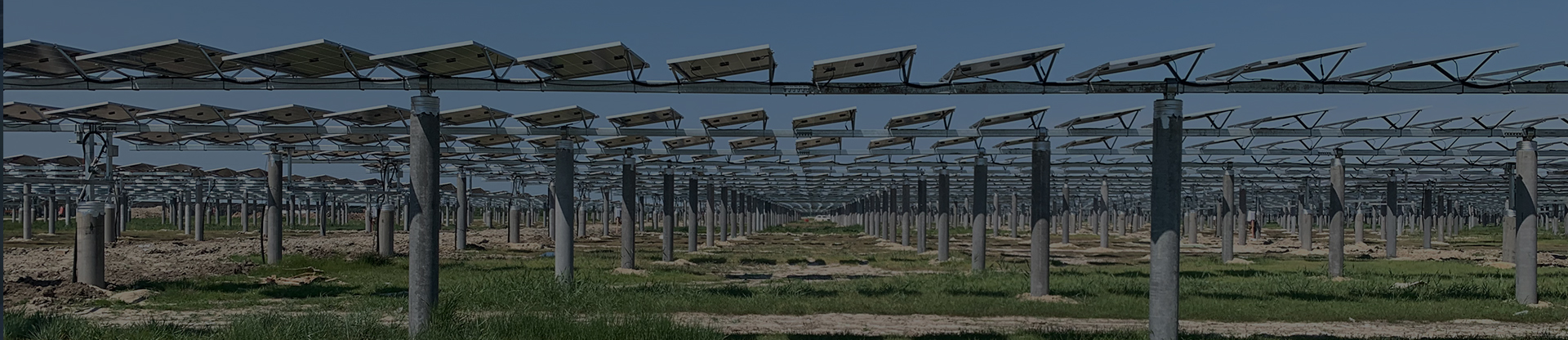

Discover how dual-axis solar trackers on weathering-steel supports turned an open-pit mining subsidence site in Yangquan, Shanxi, into a landmark PV plant with 10%+ ROI — proven in real terrain.
From "Home of Coal" to a Solar Frontier
For more than a century, Yangquan City in Shanxi Province, northern China, was defined by what lay beneath its soil. Known as the "home of coal and iron," it once stood as the country's largest anthracite production base. Over roughly 100 years, the region extracted an estimated 1.8 billion tonnes of coal and generated 140 billion kWh of electricity. It was a story of industrial glory — and of an environment shaped, and scarred, by mining.Then came the turning point. Falling coal prices, overcapacity, and mounting environmental pressure pushed Yangquan to reimagine its economic future and search for a new engine of growth.
A Difficult Site with One Unmissable Advantage


The challenge was plain. The designated land sat on backfilled open-pit mine workings in a coal mining subsidence zone — terrain marked by uneven surfaces too unstable for conventional factory construction. The soil was poor, dry, and hard to farm.Yet the same landscape hid a remarkable opportunity. Yangquan enjoys long sunshine hours, low cloud cover, high atmospheric transparency, and strong direct solar radiation. In short, the site was built for photovoltaics — a natural fit for a large-scale solar power station.
The Solution:
A Hybrid Design Engineered for Rugged Terrain
As a PV mounting system supplier to the project, Zhaori New Energy (Protracker)took on a demanding brief. The client required world-class photovoltaic conversion efficiency, with explicit targets for array efficiency, inverter efficiency, and AC grid-connection efficiency. At the same time, the uneven, subsidence-prone terrain demanded a mounting solution that could adapt — reliably and affordably.We answered with a combined "string + central" architecture and a site-matched combination of mounting systems: fixed-tilt structures, single-axis solar trackers, and dual-axis solar trackers, each deployed according to area and terrain complexity. The result is a system that squeezes more generation out of every square metre of difficult ground.
Why the Dual Axis Solar Tracker Matters Here?
For a site like Yangquan's, the dual-axis solar tracker is the decisive choice. By continuously adjusting both azimuth and tilt to follow the sun's path, a dual-axis tracker captures significantly more direct radiation than fixed or single-axis systems — a real advantage in a high-irradiance climate like this one. More tracking freedom means more daily generation hours, steadier output curves, and better seasonal performance across the year.
Paired with this intelligence is a material upgrade. Instead of ordinary carbon steel, we specified weathering steel (Corten steel) for the tracker structures. Weathering steel gains a dense protective rust layer on its surface that blocks corrosive agents from reaching the core — and the longer it serves, the more effective that protection becomes.
It delivers:

This helps to reduce the total cost, shorten the construction time, and more importantly, it enables the installation of dual-axis photovoltaic supports and photovoltaic panels even in the cold winter. At the same time, it also avoids the pollution caused by traditional anti-corrosion treatments, making the entire factory more environmentally friendly from day one.
This helps to reduce the total cost, shorten the construction time, and more importantly, it enables the installation of dual-axis photovoltaic supports and photovoltaic panels even in the cold winter. At the same time, it also avoids the pollution caused by traditional anti-corrosion treatments, making the entire factory more environmentally friendly from day one.
An Innovation-Led Power Station
This is not just a solar farm; it is a showcase of integrated innovation. The plant pairs high-efficiency monocrystalline modules with highly integrated inverters, and matches them to corrosion-resistant, terrain-smart tracking structures. The result is a cleaner, more efficient station that produces power for longer each day.The economics speak for themselves. The station delivers an internal rate of return above 10%, with distributed photovoltaic applications reaching 11%+ — compelling figures for investors weighing renewable assets in redeveloped industrial land.
Why Zhaori New Energy-Protracker
For developers facing challenging terrain — subsidence zones, slopes, or harsh climates — Zhaori new Energy delivers mounting systems that adapt. Our dual-axis solar trackers, built on durable weathering steel and matched to your site's geography, are engineered to maximise yield, minimise maintenance, and stand the test of time.When the ground is difficult, smart tracking makes the difference.