


Dual-Axis Solar Trackers for Wastewater Treatment Plants:
How a 0.8MW Tracking System Solved the Toughest Challenges
astewater treatment plants are among the best places to generate solar power — and among the hardest places to build it. They run around the clock, sit in highly corrosive conditions, and leave almost no open ground for conventional mounting.
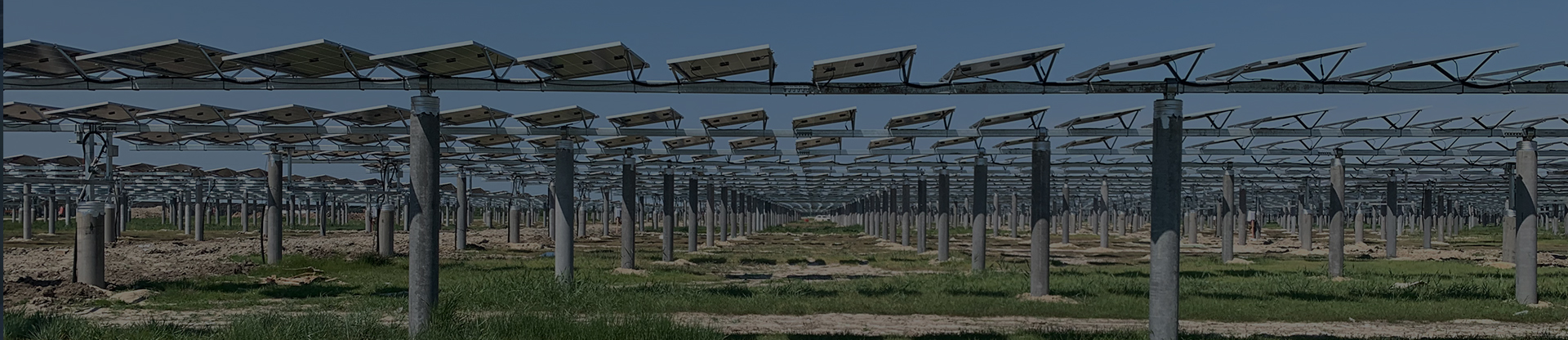
This case study shows how a fully tracking 0.8MW PV system was delivered at the Shanghai Industrial Quanshuihe Wastewater Treatment Plant (Phase II) in Dalian, China, using 108 dual-axis solar trackers (344.5kW) and 72 single-axis solar trackers (459.4kW) — a proven answer for anyone planning solar on a water treatment plant.
Why a Wastewater Treatment Plant Is an Ideal Host for Solar
Municipal wastewater treatment plants are heavy, steady electricity consumers. In China, the average energy consumption of an urban plant is about 0.292 kWh per cubic metre of treated water, and electricity is one of the biggest controllable costs in daily operation.
Because these plants draw large daytime loads at relatively high tariffs, they are a natural fit for self-consumption distributed PV under a "self-consumption with surplus fed into the grid" model. Every square metre of available site space — tank tops, rooftops, green belts — can be turned into power generation that directly offsets grid purchases.
The Real Challenges of Installing Solar on a Wastewater Plant
Building a PV mounting system on a working plant is far harder than on open land. Three problems dominate:
A Corrosive, C5-Class Environment
Fragmented Space That Rules Out Piling
Non-Stop Operation and Strict Safety

Our Solution: Tracking Mounts Plus Flexible Engineering
These challenges are exactly where specialist design and installation capabilities pay off. Our technical team answered each one in turn.
Corrosion Protection Built for a 25-Year Life
We used hot-dip galvanised steel structures with stainless-steel fasteners at critical connections. Coating thickness and surface treatment are designed for a service life of 25 years or more, validated by neutral salt-spray (NSS) testing of over 1,440 hours — the corrosion resistance a water plant demands.
Dual-Axis Trackers and Prestressed-Cable Flexible Mounting
We paired dual-axis trackers with a prestressed-cable flexible mounting system (cables, tensioning devices and support columns). The result: large spans, minimal piling and no ground occupation, engineered to absorb wind-induced dynamic loading and effectively prevent module micro-cracking — critical on long, exposed tank spans.
Non-Stop, Safety-First Construction
We planned segmented non-stop construction so the plant kept running throughout. A complete safety system covered high-altitude and water-adjacent work, including electrical safety and fall protection, backed by intelligent monitoring, O&M support and grid-connection services.

The Dalian Project: 0.8MW of Tracking Solar, Delivered
At the Quanshuihe plant (Phase II), we delivered a 0.8MW ground-mounted PV system built entirely on tracking mounts:
108 dual-axis solar trackers (344.5kW) on the green belt above the covered biological reaction tanks
72 single-axis solar trackers (459.4kW) covering the administration building and treatment workshops
The system was positioned safely among pipelines, obstacles and long-span tanks, and achieves full self-consumption under peak/valley tariffs — turning the plant's own demand into its own generation.
Results and ROI
The numbers tell the story:
Daily generation rose from 2,899 to 3,392 kWh
Annual generation revenue ≈ 1.26 million CNY
Investment increase: only ~10% (thanks to tracking mounts)
Generation revenue improvement: ~25%
Payback period shortened by about one year
For a wastewater treatment plant, this means lower electricity costs, higher on-site generation and a faster return — the exact outcomes operators care about.
Every plant is different, and the right answer depends on tank layout, span and local wind conditions. We design and supply solar trackers, flexible mounting systems and corrosion-resistant PV structures built for the realities of a working plant.